We begin with the equation itself:
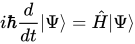
This equation governs the evolution of the wavefunction.
Nothing controversial yet.
1. What the Equation Actually Says
Formally, the equation specifies:
-
a relation between a function ψ
-
an operator
-
and a parameter t

It encodes:
how one configuration of ψ is related to another.
That is all.
No mention of:
-
particles,
-
measurement,
-
collapse,
-
observers,
-
or independent systems.
Only:
a structured relation over a space of possibilities.
2. Where Independence Enters (Quietly)
Now watch carefully.
The standard interpretation proceeds as follows:
- ψ represents the state of a system.
- The system exists independently of observation.
- The equation describes how this independent state evolves over time.
At this point, independence has already been installed.
But nothing in the equation required:
-
a system as an independently existing entity,
-
a state as something the system possesses,
-
or time as an external container in which it evolves.
These are interpretive additions.
3. The Critical Slide: From Function to Ontology
The key move is this:
treating as a property of an independently existing system.
But formally:
-
is a function over a configuration space,
-
not an intrinsic attribute of a thing.
The shift from:
-
mathematical objectto
-
ontological state of a system
is where independence is smuggled in.
4. Collapse as a Manufactured Problem
-
The equation gives smooth, continuous evolution.
-
Measurement yields discrete outcomes.
So we ask:
how does the system’s state “collapse”?
But notice:
-
collapse is not in the equation,
-
measurement is not in the equation,
-
discontinuity is not in the equation.
They arise only after we assume:
an independently existing system whose state must change.
The “measurement problem” is therefore not discovered.
It is constructed.
5. Re-reading Without Independence
Now remove the assumption.
What remains?
The equation describes:
constraint relations among possible configurations.
Measurement becomes:
-
a specification of a constraint context,
-
within which certain outcomes are actualisable.
There is no:
-
pre-existing state to collapse,
-
independent system to be disturbed,
-
external observer intervening.
Only:
-
structured possibilities,
-
and constrained actualisation.
6. Time: Another Smuggled Dependency
physical time in which the system evolves.
But formally, it is:
-
an ordering parameter.
To interpret it as:
-
an independently existing temporal container
is another insertion of independence.
Under the constraint view:
-
indexes relational order,
-
not an external timeline in which things happen.
7. The Hamiltonian: Hidden Reification
-
representing the system’s energy,
-
determining its dynamics.
But again:
-
“energy” becomes reified as a property of a system,
-
rather than understood as part of a constraint structure.
The equation itself only encodes:
invariant relations governing allowable transformations.
8. What the Equation Never Says
The Schrödinger equation does not say:
-
there exists an independent system,
-
the system possesses a state,
-
the state evolves in real time,
-
measurement causes collapse,
-
observers affect reality.
Every one of these claims is interpretive.
None are required by the formalism.
9. What Changes When Independence Is Removed
Once the smuggled assumption is removed:
-
The measurement problem dissolves.
-
Collapse disappears.
-
Observer paradoxes vanish.
-
Wave/particle duality ceases to be mysterious.
What remains is:
a constraint-governed structure of possible actualisations.
10. The General Lesson
This is not unique to this equation.
It is a pattern:
-
A mathematical formalism encodes relations.
-
Interpretation reifies elements of the formalism.
-
Independence is attributed to these reified entities.
-
Paradoxes emerge.
Remove step (3), and step (4) vanishes.
Closing Strike
The Schrödinger equation is often taken to describe:
how reality behaves independently of observation.
In fact, it only ever described:
how structured possibilities relate under constraint.
And once added, it had to be repaired.
No comments:
Post a Comment